 Drift
DriftWIN-T Increment 2
WIN-T · Army · General Dynamics · truncated
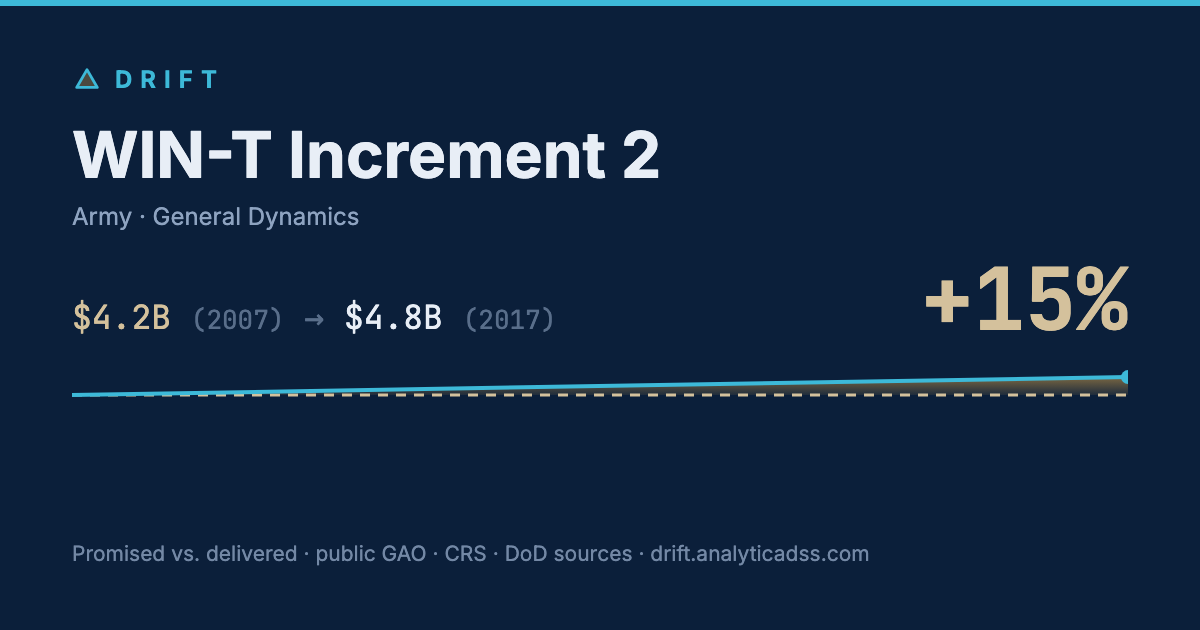
+15%
$4.2B (2007) → $4.8B (2017)
 Explore WIN-T interactively →
Download 1-page brief (PDF)
Explore WIN-T interactively →
Download 1-page brief (PDF)
Baseline
$4.2B (2007)
Current estimate
$4.8B (2017)
Cost growth
+15%
Units
1893 → 1623
Quantity change
−14%
Unit-cost change
+35%
IOC
2011 (planned) → 2013
Schedule slip
+2 yr
Cost basis
BY
Confidence
high · reconciled
Boom and descope: the Army’s battlefield network nearly TRIPLED its estimate ($4.0B for 1,893 nodes → $11.2B for 3,730 by 2016, +178.7% in FY2017$) — then the 2017 procurement halt cut it back to +15% over baseline, for 270 fewer nodes than the original plan. The row shows the end state; the note is the ride.
Source: GAO-19-336SP App. V p.202 — constant FY2019 $M: first full estimate (10/2007) $4,152.07M vs Dec 2017 $4,791.84M, +15.4%, after the Army descoped the program (−$6.5B in one year). Quantities from the WIN-T Inc 2 SAR Dec 2017 (18-F-1016 DOC 41) pp.20,33: 1,893 nodes (dev estimate) → 1,623. Peak stated in GAO-17-333SP p.83 (FY2017$): $11,209.9M / 3,730 nodes by 09/2016, +178.7%.
Drift — an independent project by Aous Abdo · Analytica DSS, built from public GAO, CRS and DoD sources. Cost growth has many causes; a larger number is not by itself evidence of mismanagement. How this is built · Explore the data →